From style icon to old hat: 
The decline of the ESPRIT brand

First they invented “fast fashion,” then they got devoured by it. They shaped the style of an entire decade, then receded into oblivion. Norbert, thinks a lot went wrong with ESPRIT, but the brand still holds the potential to inspire enthusiasm in the future. 

When I read that the ESPRIT fashion company was bankrupt and closing its 56 stores in Germany, I was shocked. For me, someone who was socialized during the 1980s, ESPRIT was a truly iconic brand. Not only did it represent an entire way of life, it also had a few design highlights up its sleeve, which we'll get to in a moment. When I related to my younger co-workers how I felt about ESPRIT, they just shrugged. Some thought it was a stupid brand. Others hadn't paid it any mind. They associated the it not with the gaudy 80s but with mainstream fashion in tones of gray and beige. “ESPRIT? dunno, it's some kind of store, isn't it?” Ouch. That's about as bad as it gets in terms of brand recognition. So I began asking myself, Where in heaven's name did they go wrong? 


In the beginning, ESPRIT was a California success story paired with a real-life love story. Susie and Doug Tompkins founded the brand in 1968. The husband-and-wife team had previously been involved in fashion in various ways. Susie was a seamstress and sold colorful hippie clothes out of a VW bus. In between trekking and kayak expeditions, Doug had founded The North Face – which he sold in order to finance the ESPRIT adventure with his new wife. Just three years later (which is impressive when you consider how difficult networking was back then) ESPRIT was a global company, producing clothes in Asia, with a store in Hong Kong. Things were off to a good start!


Success and love come to an end

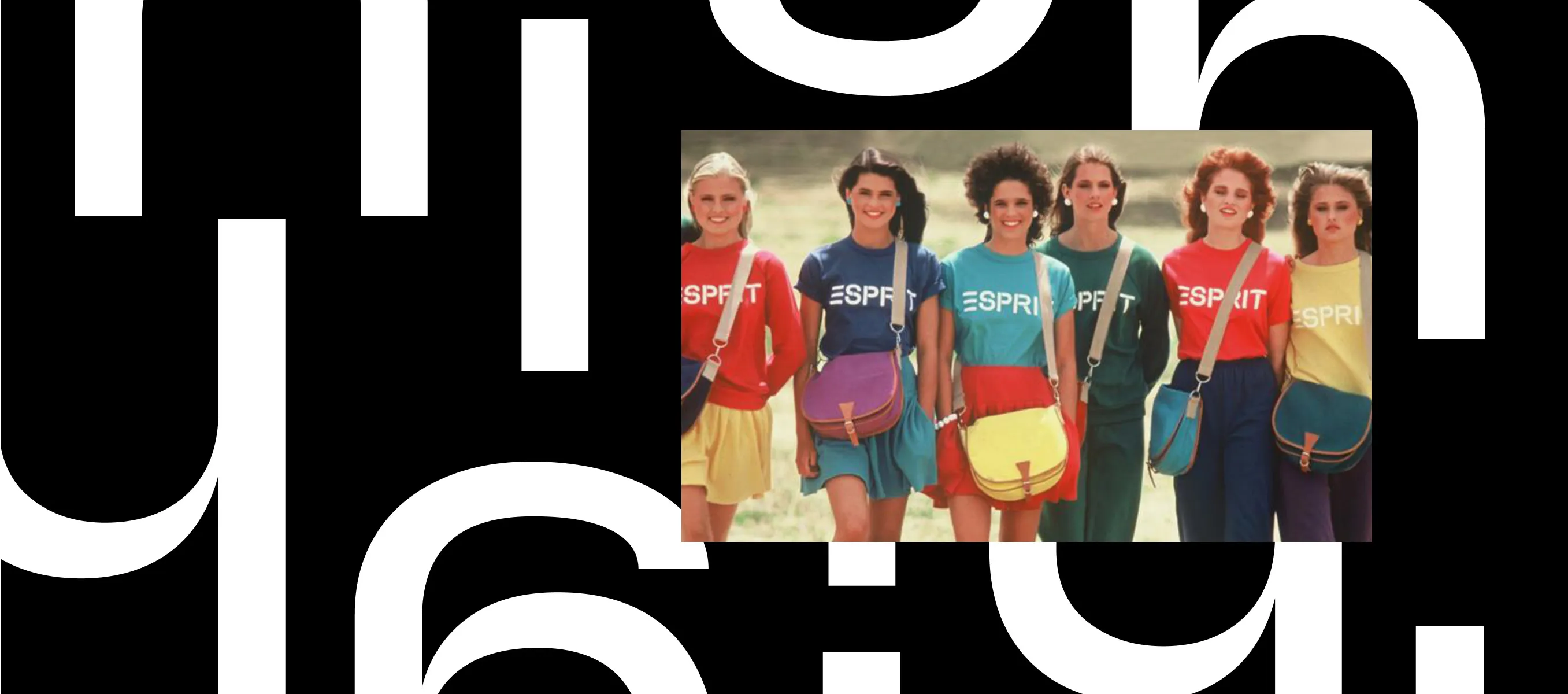
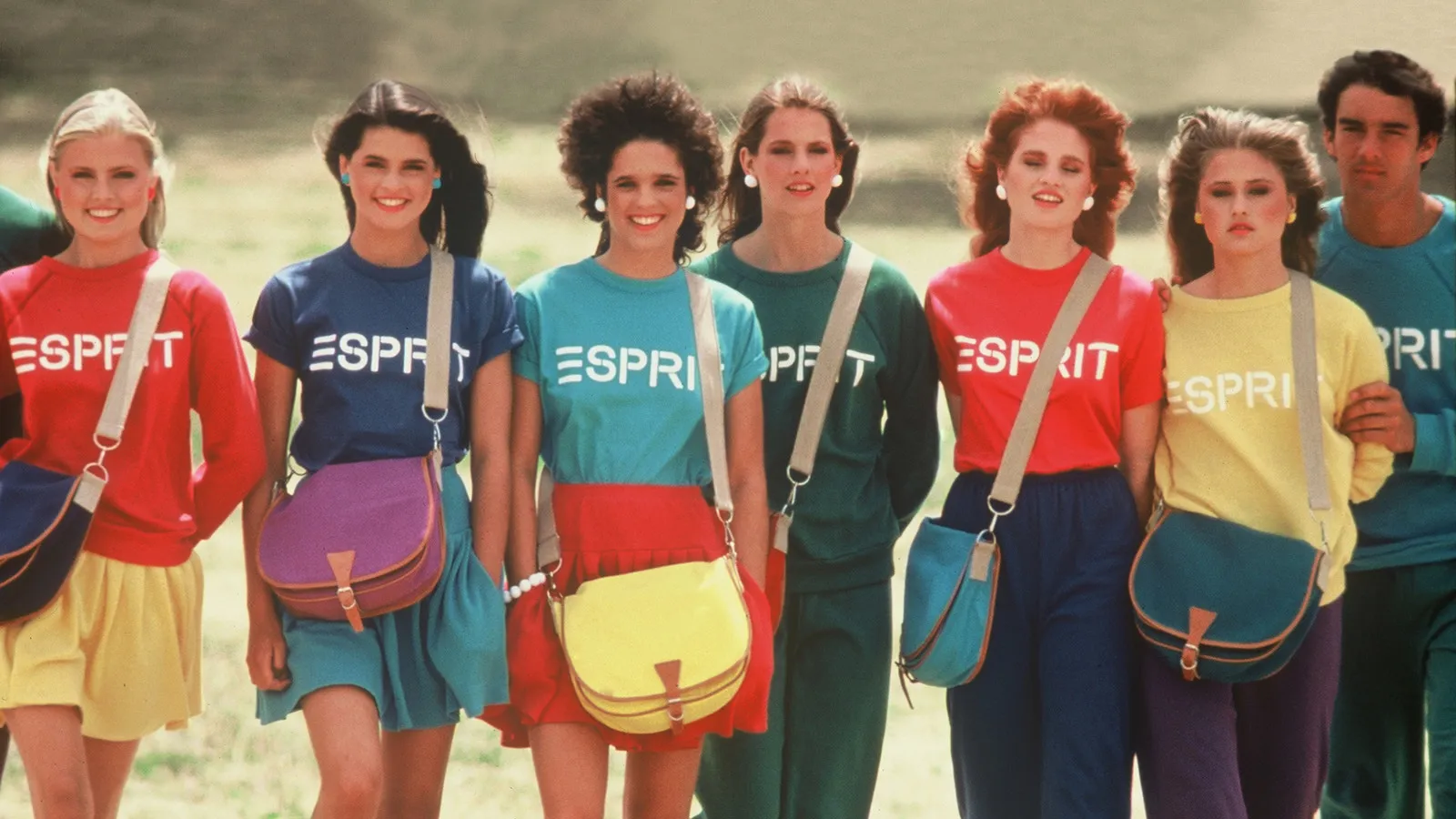
Like I said, if you were a young person in the 1980s, you can remember when the ESPRIT brand was still cool. The clothes weren't anything spectacular, but they had a West Coast vibe. The postmodern mix of colors, patterns, and shapes– along with the extensive range of products including bags, shoes, and watches – was all part of the New Wave era. But in 1987, dark clouds appeared on the horizon when the company lost money for the first time. That led to tension between Doug and Susie Tompkins – and ended both the love story and the success story. Doug left the company in 1989, and ESPRIT's economic decline accelerated. 

Of course, a lot was happening in the world in 1989. The Berlin Wall fell, and the age of Glasnost was in full swing, with the world opening up fast. Markets were reorganizing themselves, and brands sensed new business opportunities. Companies began expanding, and attitudes about life changed radically. Suddenly the angst of the 1980s – the decade of Cold War, AIDS, and Chernobyl – seemed incredibly far away. And in a society free of fear, cheerful and optimistic fashion statements seemed somehow obsolete. 


The wrong time for the right values

In this phase, Susie Tompkins makes what seemed like the wrong decisions. Under her leadership, ESPRIT brings an environmentally conscious collection made of organic cotton to the shops and launches campaigns about animal rights and other issues. From today's perspective, the company was ahead of its time, but in doing so it neglected what might have been its biggest advantage. Mass production in Asia may have been the origin of what we now know as “fast fashion” – but it is precisely in this area that the brand lost ground to new competitors. In the early 90s, ZARA converted to a just-in-time system in its factories, bringing new collections to its stores within just a few weeks. H&M also expanded and targeted ESPRIT's core young clientele with affordable fast fashion. 


All this occurred in the midst of a brick-and-mortar shopping frenzy that seems like ancient history to us today. Crowded shopping streets were packed with multiple H&M outlets – and one lonely ESPRIT store, a relic of the “good old days.” In the battle for market share among the coveted target groups, ESPRIT's share of the pie grew smaller and smaller. And just as the company was still frantically investing in new retail stores, the next trend delivered another blow: The fashion industry started moving online. ASOS started up in 2000, and Zalando in 2008. ESPRIT made a profit for the last time in 2013. The rapid decline that followed parallels that of Germany's department stores. Locations were closed, subsidies were applied for, insolvency proceeding were inevitable. It was a difficult process, and ten years later it finally became clear things couldn't go on any longer.

Doug Tompkins recruited the most creative minds of the 1980s to work for ESPRIT.

One of the strongest brands of our time

The story's ending is tragic. For the 1300 employees who will lose their jobs, and for one of the most powerful brands of the past 50 years. A brand that succeeded in turning interchangeable products into a cult, ESPRIT never stood for unusual, independent design. What it embodied was a lifestyle. A good standard of quality, cheaply produced. Colorful T-shirts that became desirable because of the logo they displayed – that's phenomenal, from a marketing point of view! 


The wordmark was created in 1978 by graphic designer John Casado. It's in a stencil font, and its color changed depending on the use and season. John Casado explained the inspiration for his design like this: The clothing is cheaply produced in China and shipped to all markets, so a font reminiscent of what you might see on shipping containers is very appropriate. “This is supposed to be a concept?” Doug Tompkins is said to have asked at the time. And Casado replied: “It's a concept like any other. It depends on what you do with it.” 


And Tompkins made the most of it. He did exactly the right thing to turn the stencil font into an icon and boost the brand. For the company's ad campaigns and catalogs, he hired Oliviero Toscani, a photographer who was both famous and polarizing. Toscani eschewed well-known models. He improvised, employing large-scale formats and making sure every motif showed motion. Meanwhile the shops were designed by Ettore Sottsass, who became a legend is in his own time through his designs for Olivetti and Alessi. He founded the Memphis Group, which today is considered almost synonymous with postmodernism. Equally sensational was the company's packaging design, which was developed by Tamotsu Yagi. In short, Doug Tompkins recruited the most creative minds of the 1980s to work for ESPRIT. He thought big, and he thought it through.

An inconsistent revival

And that is precisely what sets that era apart from the revival attempts of recent years. It cannot be said that ESPRIT didn’t try to jump on the 80s revival bandwagon. There was a throwback collection in 2019, and since 2022 a new management team led by CEO William Pak has been trying to reposition the brand by drawing on the heritage of the 80s, using it as inspiration for both fashion and branding, without being too retro at the same time. Pop-up stores appeared in the US – and yet the brand failed to consistently communicate its image shift. Nothing illustrates this better than an anecdote that Pak tells about some German girls who visited the New York store. They didn't recognize the brand they knew, and went on a shopping spree.  


I am convinced that the brand can still inspire today. It has value. But two things are needed to successfully revive it: Firstly, ESPRIT must be clear about who the target group should actually be – because wanting to make fashion for everyone creates a diffuse image. Secondly, a fresh start requires bold investments. To paraphrase Doug Tompkins: Who are the Toscanis, Sottsass's and Yagis of today? 


The British financial investor Alteri Partners is now grappling with these decisions. Not only has it secured the trademark rights, it also owns the CBR Fashion Group with the brands Cecil and Street One. It is managed by Jim Nowak, a manager with an ESPRIT past. Is he also counting on an ESPRIT future? We can look forward to it. The brand toolbox at his disposal is definitely enticing.

The latest contributions exclusively on W&V: 

This design column by Norbert has been published on W&V online. As a W&V member, you will also find the latest articles from his series there.

Meet the author

Norbert
Executive Creative Director

Mail to Norbert